Simmonds' test (also called the Thompson test or Simmonds-Thompson test) is used in lower limb examination to test for the rupture of the Achilles tendon.[1][2] The patient lies face down with feet hanging off the edge of the bed. If the test is positive, there is no movement of the foot (normally plantarflexion) on squeezing the corresponding calf, signifying likely rupture of the Achilles tendon.[3]

Interpretation of results
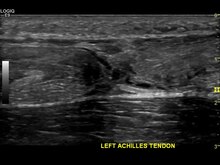
Recent research has indicated that while the Simmonds' test is an accurate detector of achilles rupture, it is unable to distinguish between partial tear (tear of the gastrocnemius or soleal portion only) and a complete tear of both portions. [4]
 Play media
History
The test is named after Franklin Adin Simmonds (1911-1983), an English orthopaedic surgeon at the Rowley Bristow Hospital, Surrey.
| This article uses material from the Wikipedia article Metasyntactic variable, which is released under the Creative Commons Attribution-ShareAlike 3.0 Unported License. |