In medicine, the mean arterial pressure (MAP) is an average blood pressure in an individual during a single cardiac cycle.[1]
CalculationEditThe Systemic Vascular Resistance (SVR), denoted  is represented mathematically by the formula
 ,[2] where
  is the change in pressure across the systemic circulation from its beginning to its end and
 is the flow through the vasculature (equal to cardiac output)
another type of equation is:
![{\displaystyle MAP=[Systolic+2(Diastolic)]/3}](https://wikimedia.org/api/rest_v1/media/math/render/svg/1466a82acc81ff1523ae5c44f88724ea57380285)
In other words:
Systemic Vascular Resistance = (Mean Arterial Pressure - Mean Venous Pressure) / Cardiac Output
Therefore, Mean arterial pressure can be determined from:[3]

where:
 is cardiac output
 is systemic vascular resistance
 is central venous pressure and usually small enough to be neglected in this formula.
EstimationEditWhile MAP can only be measured directly by invasive monitoring it can be approximately estimated using a formula in which the lower (diastolic) blood pressure is doubled and added to the higher (systolic) blood pressure and that composite sum then is divided by 3 to estimate MAP. In patients with sepsis, the vasopressor dosage may be titrated on the basis of estimated MAP.[4]
This is only valid at normal resting heart rates during which  can be approximated using the measured systolic (
 ) and diastolic (
 ) blood pressures:[5][6][7]

or equivalently

or equivalently
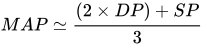
or equivalently
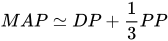
where  is the pulse pressure,
At high heart rates is more closely approximated by the arithmetic mean of systolic and diastolic pressures because of the change in shape of the arterial pressure pulse.
For a generalized formula of :

Where HR is the heart rate.[8]
Clinical significanceEdit is considered to be the perfusion pressure seen by organs in the body.
It is believed that a that is greater than 70 mmHg is enough to sustain the organs of the average person. is normally between 65 and 110 mmHg.[9] Even 1 minute at a mean arterial pressure of 50 mmHg, or accumulative effects over short periods, increases the risk of mortality by 5% and can result in organ failure or complications.[10][11] MAP may be used similarly to systolic blood pressure in monitoring and treating[clarification needed] for target blood pressure. Both have been shown advantageous targets for sepsis, major trauma, stroke, intracranial bleed, and hypertensive emergencies.[12]
If the falls below this number for an appreciable time, vital organs will not get enough oxygen perfusion, and will become hypoxic, a condition called ischemia.