Grey Turner's sign refers to bruising of the flanks, the part of the body between the last rib and the top of the hip. The bruising appears as a blue discoloration,[1] and is a sign of retroperitoneal hemorrhage, or bleeding behind the peritoneum, which is a lining of the abdominal cavity. Grey Turner's sign takes 24–48 hours to develop, and can predict a severe attack of acute pancreatitis.[2]
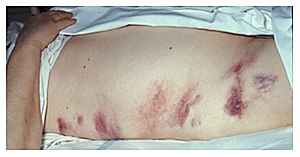
Grey Turner's sign may be accompanied by Cullen's sign. Both signs may be indicative of pancreatic necrosis with retroperitoneal or intra-abdominal bleeding. Grey Turner's sign is named after British surgeon George Grey Turner.[3]
Causes
Causes include
- Acute pancreatitis, whereby methemalbumin formed from digested blood tracks subcutaneously around the abdomen from the inflamed pancreas.
- Pancreatic hemorrhage[1]
- Retroperitoneal hemorrhage[1]
- Blunt abdominal trauma
- Ruptured / hemorrhagic ectopic pregnancy.
- Spontaneous bleeding secondary to coagulopathy (congenital or acquired)
- Aortic rupture, from ruptured abdominal aortic aneurysm or other causes.[1]
History
It is named after British surgeon George Grey Turner.
| This article uses material from the Wikipedia article Metasyntactic variable, which is released under the Creative Commons Attribution-ShareAlike 3.0 Unported License. |